Stories
Annaprashan ceremony: a Kolkata grandmother, one silver spoon and a baby's first rice
A short story of a grandmother in Kolkata who waited six months to hand over a silver spoon her own mother gave her. After it: what annaprashan means, when to hold it, what happens in order, what the objects on the tray are said to mean, what the baby actually eats, and invitation lines in English, Hindi and Bengali.
The FunctionCard team
· 17 min read
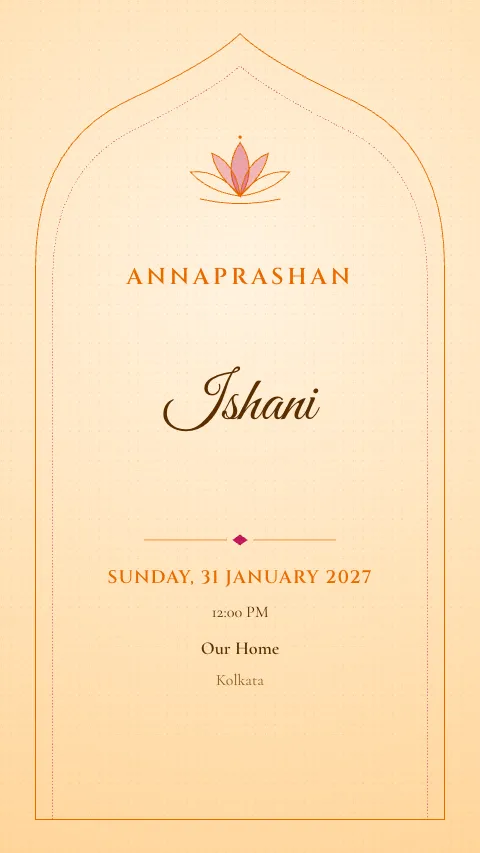
The annaprashan ceremony is one of the smallest functions a family holds and one of the most remembered: a baby of about six months, dressed in new silk, tastes rice for the first time while the whole family leans in to watch. Below is one such morning, told as a story through the grandmother who planned it. After the story comes what a family planning its own annaprashan needs: what the word means, the right age, the rituals in order, what the baby really eats, what the objects on the tray stand for, and how to invite the people who should be there.
Quick answer
What is the annaprashan ceremony?
Annaprashan is the Hindu ceremony, one of the sixteen samskaras, at which a baby is fed cooked rice, its first food other than milk. It is usually held around the sixth month after a puja on an auspicious date. A parent, grandparent or, in Bengali homes, the maternal uncle feeds the first grain, and relatives come to bless the child and share a meal.
A story
Didima's silver spoon
Chapter 1
A date from the panjika
Sukhalata Ghosh had kept the spoon in a red cloth pouch at the back of her steel almirah in Behala for forty-one years. It was small, thin with polishing, with a tiny lotus where the handle met the bowl. Her mother had put it in her hand on the morning of her own son's annaprashan and said only, "Next time, it goes to the next one." The next one had taken a long time to arrive.
When her daughter Rimi rang from Pune to say the baby was five months old and putting everything in her mouth, Sukhalata was already holding the panjika open on her lap. She ran her finger down the columns of the almanac, muttering, while her husband pretended to read the newspaper. "Girls in the odd months," she said. "The seventh is too late, the fifth is gone. There is a good day in the first week of the sixth, but then we do it for her health, not for the stars." Rimi laughed and said the paediatrician had said six months anyway.
So it was fixed: a Sunday morning in Behala, a puja at home, lunch for the family after. Baby Aranya, whom everybody already called Mishti, would fly in with her parents. Her mama, Rimi's brother Bablu, would fly in from Bengaluru to feed her the first rice, as a maternal uncle does in Bengali homes. "Tell Bablu," said Sukhalata, "that if he misses the flight, I will feed her myself and he will hear about it for the rest of his life."
Chapter 2
An invitation in Didima's voice
Rimi made the invitation on her phone one night while Mishti slept on her chest. She chose a design with a red-and-white border like a laal paar saree and marigolds along the top, and gave the morning two parts: the puja at nine, with only the family, and lunch at one, with everyone. Each part got its own time and the same map pin to the house in Behala, so the cousins who had never been there could find the lane behind the sweet shop.
Then she called her mother. "Ma, say something. It will play when they open the invitation." Sukhalata held the phone too far from her face and spoke slowly, as if she were on the radio: "Our Mishti is eating her first rice. Come and bless her. Lunch is at one. Do not be late, the fish will not wait." Rimi listened to it four times and kept it exactly as it was, cough and all.
The replies came in over the week. The lunch total climbed to fifty-eight and Rimi sent the number to the cook, Shibu-da, who had cooked for Bablu's thread ceremony twenty years earlier and still remembered who had asked for second helpings of mutton. Rimi's school friend in Toronto couldn't come, so she sent a blessing and shagun from the invitation instead, with a line that said: For Mishti's first silver plate.
Chapter 3
The morning of the first rice
On the Sunday, the drawing room in Behala smelt of incense, ghee and frying. Mishti sat on her mother's lap in a tiny red-bordered silk outfit, a gold-paper crown slipping over one eye and a dot of sandalwood paste on her forehead. The purohit lit the lamp, the women blew the conch and called out the ulu, and Mishti, who had never heard so much noise in one room, decided to look very serious about all of it.
Her grandmother blessed her first with dhaan-durbo, a few grains of paddy and blades of durva grass touched to her head. Then Bablu, still in the kurta he had slept in on the flight, sat cross-legged in front of the silver plate. On it were tiny portions of everything: rice, dal, a fried piece of begun, shukto, fish, and payesh in a silver bowl. Most of it was for show and for the photographs. Only the rice and the payesh would actually go near the baby.
Sukhalata untied the red pouch and handed him the spoon. "Just a grain," she said. "She is not a guest at a wedding." Bablu took the smallest touch of soft rice on the lotus spoon and held it to Mishti's lips. Mishti looked at him, looked at the spoon, and opened her mouth. The room cheered as if a goal had been scored. Then she made a face, and the room cheered again.
Chapter 4
The tray
Next came the part the cousins had been waiting for. Rimi's aunt set down a brass tray with five things on it: a small book, a pen, a lump of earth from the garden in a clay saucer, a gold coin, and a handful of rice. Whatever Mishti touched first, the family would pretend to read her future in it. Bets were placed. Bablu said the pen, because she would be a writer like her grandfather. Rimi's husband, an engineer, put his money on the book.
Mishti studied the tray for a long time, reached past all five things, and grabbed the edge of her grandmother's saree. Nobody had a meaning ready for that. "She has chosen her Didima," said Sukhalata, very pleased, and no one argued. A cousin pointed out that technically she had touched the rice on the way, and the family voted to count both.
Chapter 5
What goes to the next one
Lunch ran long, as lunches in Behala do. Shibu-da's fish was finished by two, the mutton by half past, and the elders slept in the bedroom while the cousins watched the video of the tray on a loop. Mishti slept through her own feast in a cot by the window, her crown finally off.
In the evening, while Rimi packed, Sukhalata washed the spoon herself, dried it in the end of her saree, and put it back in its red pouch. Then, instead of carrying it to the almirah, she put it in Rimi's suitcase between the baby's clothes. "Next time," she said, "it goes to the next one. That's the rule." Rimi asked whose rule it was. "My mother's," said Sukhalata. "And now yours."
The Ghoshes are a made-up family, but most of their morning happens in real homes: a date checked in the almanac and then checked against the baby's readiness, a small family puja followed by a bigger lunch, a maternal uncle with the first spoonful, a plate of dishes the baby mostly doesn't eat, and a tray of objects that gets everyone laughing. Here is what each part means and how to plan it.
Meaning
What does annaprashan mean, and what is it called in English?
Annaprashan joins two Sanskrit words: anna, cooked grain or food, and prashan, feeding or eating. In English it is usually called the first rice ceremony or the first feeding ceremony. It is one of the sixteen samskaras, the rites that mark a Hindu life from before birth to after death, and it comes after the naming ceremony and before the first haircut. Its meaning is simple: the child is moving from mother's milk to the food the family eats, and the family asks for that food to keep the child healthy. Many families pray to Annapurna, the goddess of food, or begin with Ganesh, before the first grain is given.
Across India
What is annaprashan called in different regions?
One ceremony, many names
Bengal
Mukhe bhaat, rice in the mouth. The maternal uncle usually feeds the baby, and the plate holds a full Bengali meal in miniature with payesh.
Kerala
Choroonu, often held at a temple; many families take the baby to Guruvayur for it, and payasam is part of the offering.
Odisha and Assam
Usually called annaprashan, with kheer and a family feast after the puja.
Gujarat and Maharashtra
Usually just annaprashan, often a small puja at home with kheer and a lunch for close family.
Himachal Pradesh
Bhaat khulai, the opening of rice, sometimes held together with other family pujas.
Nepal
Pasni: boys at about six months and girls at about five, with an elaborate plate and a tray of objects much like Bengal's.
Timing
What is the right age for annaprashan?
Most families hold the annaprashan at around six months. Many traditions prefer even months for boys (the sixth or eighth) and odd months for girls (the fifth or seventh), and the day itself is chosen from an almanac or by the family priest. In practice, families now fix the month by the baby's readiness and the paediatrician's advice, and use the almanac to choose the day within it. If the right month has passed, it is held later; there is no rule that it can't be done at eight or ten months, and some families combine it with the first birthday.
A grain, not a meal
The ceremony is about the first taste. Babies starting solids need tiny amounts of soft, plain food, so most families let the baby take just a touch of soft rice or a lick of payesh and keep the full plate for the photographs and the guests. Ask your paediatrician what is right for your baby, especially about sugar, salt, honey and anything the baby hasn't had before.
The morning
What happens at an annaprashan ceremony, step by step?
- 1Bath and new clothesThe baby is bathed and dressed in new clothes, often silk; in Bengal a red-bordered outfit and a paper or sola crown, with sandalwood dots on the forehead.
- 2The pujaA priest or an elder lights the lamp and offers prayers, often to Ganesh and Annapurna, sometimes with a short havan. The food for the baby is offered first.
- 3BlessingsElders touch the baby's head with grains, grass or flowers; in Bengali homes with dhaan-durbo, paddy and durva grass, while the women blow the conch and call the ulu.
- 4The first grainA parent, grandparent or maternal uncle feeds the baby a tiny amount of soft rice or kheer, often with a silver spoon kept for the purpose.
- 5The tray of objectsA few objects are set in front of the baby, and whatever the baby touches first is read, playfully, as a sign of the future.
- 6Lunch and giftsRelatives bless the baby, give gifts and shagun, and the family shares a meal.
Just for fun
What are the items placed in front of the baby at annaprashan?
The objects vary by family, but five turn up most often: a book, a pen, soil or clay, gold or money, and rice or paddy. Some families add a musical instrument, a stethoscope, a cricket ball or a calculator. Nobody takes the result seriously, and that is the point: it gives the whole room a reason to lean in and laugh. Tap an object to see what families usually say it means.
Quick pick
Which object will the baby reach for first?
Tap the one that sounds like you.
The plate
What food is served at an annaprashan?
Two meals happen at once. The baby's plate is ceremonial: soft rice with a little ghee, and kheer or payesh, which in many homes is the only part that actually reaches the baby. In Bengali homes the plate also holds tiny portions of a full meal (rice, dal, a fried vegetable, shukto, fish and payesh), each touched to the baby's lips or simply shown, because the plate is a wish that the child will always eat well. The guests' lunch is a proper feast in the family's own style: fish and mutton in Bengal, sadya on a banana leaf in Kerala, puri, sabzi and kheer in many North Indian homes. Because the guest list is mostly family, the lunch is often cooked at home or by a cook the family has used for years.
Planning
How do you plan an annaprashan ceremony at home?
An annaprashan plan, four weeks out
Four weeks before
Ask your paediatrician about starting solids, then fix the day with the family priest or the almanac. Decide whether it's at home, at a temple or in a small hall.
Three weeks before
Book the priest, the cook or caterer, and the person who'll feed the baby (in Bengali homes, make sure the mama can travel).
Two to three weeks before
Send the invitation, with the puja and the lunch as separate times if only family comes to the puja, and an RSVP so you know how many to feed.
One week before
Buy the baby's new clothes, the silver spoon or plate if it isn't an heirloom, and the objects for the tray. Confirm the headcount with the cook.
The day before
Send a reminder with the time and the map. Keep the morning's schedule around the baby's sleep, not the other way round.
On the day
Puja, first grain, the tray, then lunch. Keep the baby's part short; the guests can carry on without them.
Plan around the nap
A six-month-old has about two good hours in the morning. Put the puja and the first grain early, keep the tray straight after, and let the lunch run as long as the elders like while the baby sleeps.
Invitations
How do you invite guests to an annaprashan?
Annaprashan invitations usually go to family and close friends, two to three weeks ahead, often with the puja and the lunch as separate times. With a FunctionCard invitation each part can be its own function, with its own time, venue map, add-to-calendar button and RSVP, so you see the lunch headcount separately and can invite some guests only to the lunch. You can add music, a photo of the baby and a short voice message from a grandparent that plays when the invitation opens; relatives who can't come can send a blessing or shagun by UPI from the invitation itself. Every family's personal link greets them by name. Need other wording? Try the free invitation message writer.
Annaprashan invitation lines
Our little [Name] is ready for her first taste of rice! Please join us for her annaprashan on [Date]: puja at [Time], lunch at [Time], at [Venue].
With the blessings of our elders, we invite you and your family to the annaprashan of our son [Name] on [Date] at [Venue]. Lunch will follow the puja.
Milk till now, rice from today! Come and bless [Name] at his first rice ceremony on [Date], [Time], [Venue].
One silver spoon, one tiny grain and a whole family watching. You're invited to [Name]'s mukhe bhaat on [Date] at [Time].
[Name] is six months old and has started eyeing everyone's plate. Join us for her annaprashan and a family lunch on [Date] at [Venue].
Please bring your blessings, and your appetite: [Name]'s annaprashan, [Date], puja at [Time], lunch to follow.
अन्नप्राशन संस्कार के निमंत्रण
हमारे लाडले [नाम] के अन्नप्राशन संस्कार में आप सपरिवार सादर आमंत्रित हैं। दिनांक [तारीख], पूजा [समय], भोजन [समय], स्थान [पता]।
ईश्वर की कृपा और बड़ों के आशीर्वाद से हमारी बिटिया [नाम] पहली बार अन्न ग्रहण करेगी। इस शुभ अवसर पर आकर उसे आशीर्वाद दें। [तारीख], [स्थान]।
दूध से अन्न तक का पहला कदम: [नाम] के अन्नप्राशन पर [तारीख] को [समय] बजे आपकी प्रतीक्षा रहेगी। पूजा के बाद भोजन।
অন্নপ্রাশনের আমন্ত্রণ
আমাদের আদরের [নাম]-এর অন্নপ্রাশন উপলক্ষে আপনাকে সপরিবারে সাদর আমন্ত্রণ জানাই। তারিখ: [তারিখ], সময়: [সময়], স্থান: [ঠিকানা]।
শুভ অন্নপ্রাশন: আমাদের ছোট্ট [নাম]-এর মুখে প্রথম ভাত। আশীর্বাদ নিয়ে অবশ্যই আসবেন, এই অনুরোধ রইল।
[তারিখ]-এ [নাম]-এর মুখেভাত। সকালে পুজো, দুপুরে একসঙ্গে খাওয়াদাওয়া। আসবেন কিন্তু!
Try it live
This is what your guests see
A mukhe bhaat design from the store, playing as guests see it. Tap the envelope and turn the sound on; the puja and the lunch each get their own time, map and RSVP.
- 1Tap the envelopeIt opens on the guest's screen, with your wax seal and monogram.
- 2Your music beginsTurn the sound on: the song starts as the card unfolds.
- 3The pages come aliveScroll through animated pages, with petals, confetti or lanterns.
Annaprashan designs
See all
First Rice
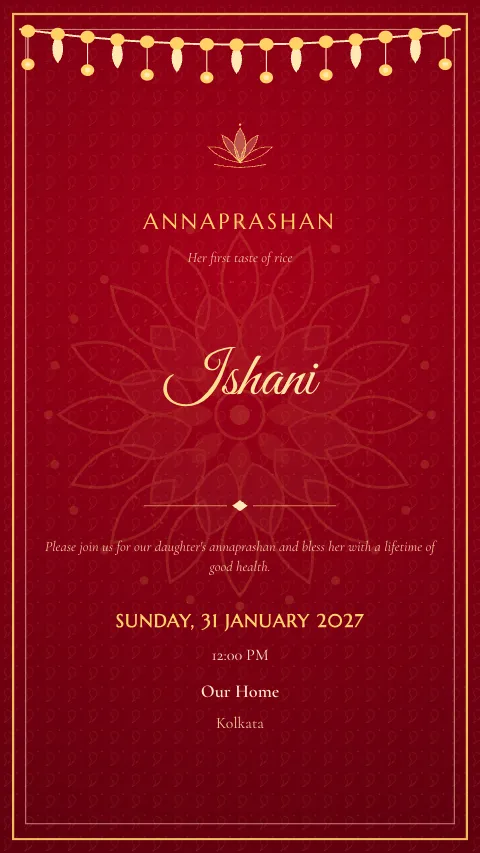
Laal Paar
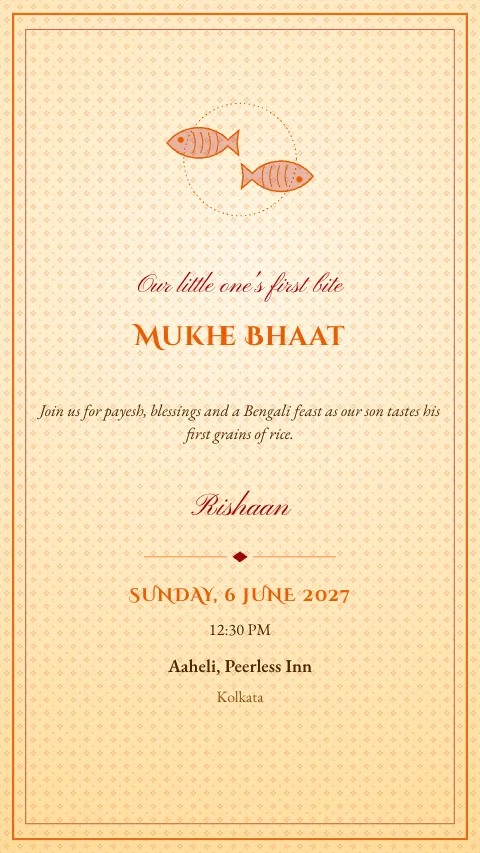
Payesh & Blessings
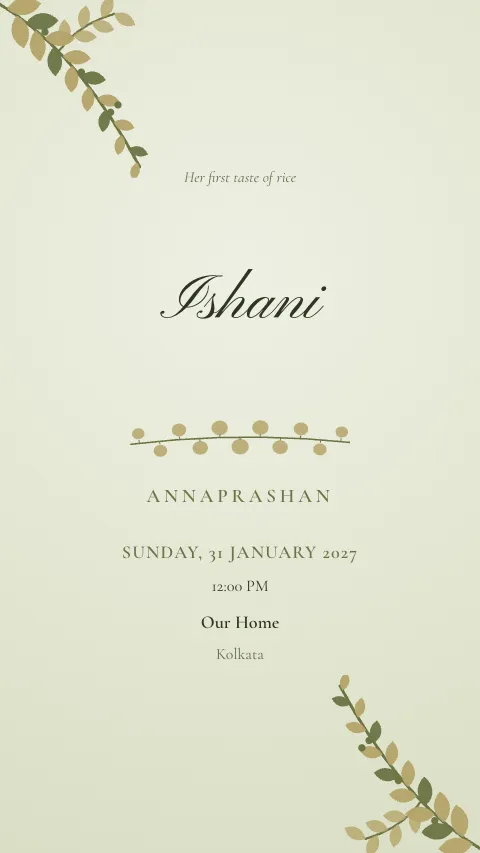
Banana Leaf Feast
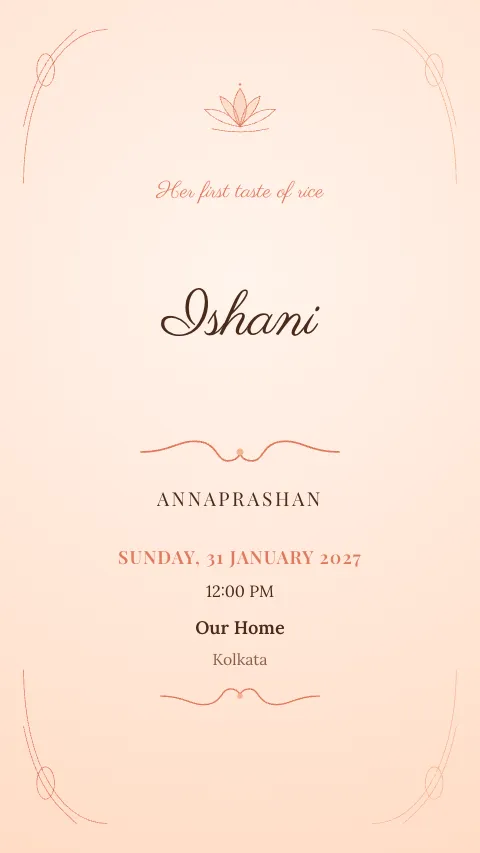
Kheer & Blessings
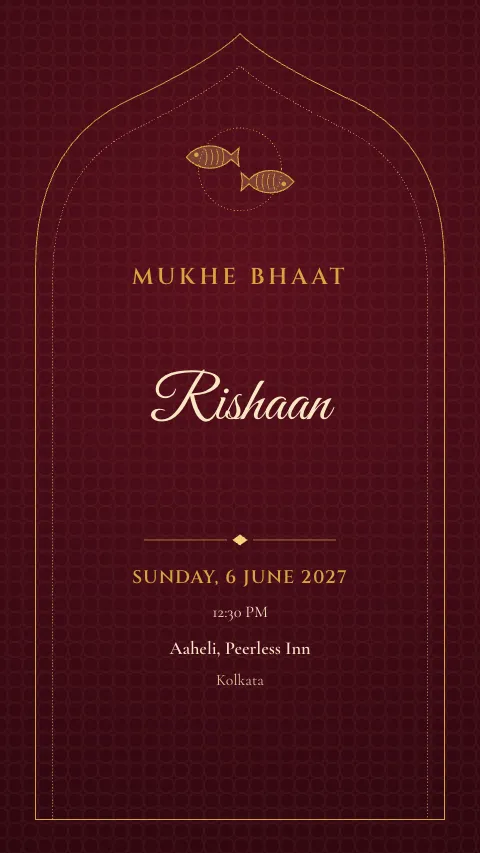
Shubho Annaprashan
Free to customise: change every word, colour, photo and the music, then share one link.
Every design can be changed freely: the words, the colours, the music and the baby's photo. See a full design on its own page, such as this first rice design, or browse all the annaprashan designs and the rest of the baby ceremonies. Designing and previewing are free; publishing one invitation, with the puja and the lunch as separate functions, is ₹399 plus GST, as the pricing page explains. Planning the first birthday next? Our birthday invitation messages include lines for it.
Key takeaways
- Annaprashan is the first rice ceremony: the baby's first food other than milk, one of the sixteen samskaras.
- It is usually held around six months; many traditions prefer even months for boys and odd months for girls, with the day chosen from the almanac.
- A parent, grandparent or, in Bengal, the maternal uncle feeds a tiny amount of soft rice or kheer, often with a silver spoon.
- The tray of objects (book, pen, soil, gold, rice) is a game, not a prophecy, and usually the best moment of the day.
- Keep the baby's part short and early, and give the puja and the lunch separate times and RSVPs if the guest lists differ.
Questions people ask
What is annaprashan in English?
In which month should annaprashan be done?
Who feeds the baby first at annaprashan?
What are the five items kept in front of the baby?
What food is given to the baby at annaprashan?
Can annaprashan be done at home?
What gift should you give at an annaprashan?
When should annaprashan invitations be sent?
Free to design · the puja and the lunch, each with its own time, map and RSVP
Invite the family to the first rice
Read next