Stories
Mehndi ceremony: a Jodhpur afternoon of henna, songs and one hidden initial
A short story of a mehndi afternoon in a Jodhpur haveli, told through the cousin who hides the groom's initial in the bride's palm. After it: what the ritual means, what happens when, what guests wear, how to get a dark colour safely, and invitation lines to copy.
The FunctionCard team
· updated · 16 min read
Ask anyone about a mehndi ceremony and they will tell you about a smell first: wet henna, eucalyptus oil and the lemon-and-sugar mix that someone dabs on every half hour. Then the songs, the aunt who would not stop dancing, the bride who could not eat with her own hands. Below is one such afternoon, told as a story, and after it everything a family planning its own mehndi needs: what it means, how the day runs, what guests wear, how to get a deep colour without risk and how to invite the right people.
Quick answer
What is a mehndi ceremony?
A mehndi ceremony is a pre-wedding celebration in which a paste of henna leaves is drawn in patterns on the bride's hands and feet, and often on the hands of female relatives and guests. It is held one or two days before the wedding, usually with songs, dancing and food, and the deep colour the henna leaves is a blessing and a sign of joy for the marriage.
A story
The hidden letter at the Rathore haveli
Chapter 1
Cones from Sojat
The henna came from Sojat, as it had for every wedding in the Rathore family that anybody could remember. Bade Papa drove the two hours to Pali district himself and came back with a cloth bag of green powder so fine it rose like smoke when Shabnam Aapa opened it on the verandah of the old haveli in Jodhpur's Sardarpura.
Shabnam Aapa had drawn mehndi for this family for twenty-two years: for Pooja's mother, for both her aunts, for the cousins one by one. She mixed the powder the night before with strained black tea, lemon juice, a little sugar and a few drops of eucalyptus oil, covered the steel dabba with a damp cloth and left it to rest. "Henna is like dough," she told Tanvi, who was nineteen and watching every step. "If you hurry it, it sulks."
By ten in the morning she had rolled thirty plastic cones, each tied with a thread and snipped at the tip with tiny scissors. Tanvi, an architecture student home from Ahmedabad, sat beside her with a sheet of tracing paper, practising the same letter again and again until it disappeared into the curl of a peacock's feather.
Chapter 2
The letter in the peacock
Pooja sat on a low divan in the courtyard with her palms open on a cushion, and Shabnam Aapa began where she always began, with a dot in the centre of the right palm, then a ring of petals around it. The patterns grew outwards: a doli carried by four tiny bearers along the wrist, a pair of elephants with raised trunks, a bride's face in profile and, on the left palm, a groom with a sehra.
When she reached the peacock on the right hand she stopped and passed the cone to Tanvi without a word. That had been agreed a week earlier. Tanvi bent over her cousin's palm, her tongue between her teeth, and drew the letter A for Arjun inside the eye of a feather, so small and so tangled in the vine around it that even Pooja, looking straight at it, could not find it. "He has to search for it after the wedding," Tanvi said. "If he can't find it, he owes you a gift."
"And if he finds it in a minute?" Pooja asked. Shabnam Aapa laughed. "Then your cousin has drawn it badly."
Chapter 3
Dholak and sugar water
By three o'clock the courtyard was full. Pooja's mother had hired two more artists for the guests, and they sat on durries along the wall, drawing quick vines and mandalas on one palm each for the aunts, the neighbours and the college friends who had come in green and yellow. Badi Mami brought out the dholak and the women sang the old banna-banni songs, teasing the groom's family in verses that grew ruder as the afternoon went on.
Pooja could not hold a cup or a plate, so Tanvi fed her kachori in small pieces and held a glass of nimbu-paani to her mouth with a straw. Every half hour somebody dabbed the drying henna with cotton dipped in lemon and sugar so it would stay on longer and darken more. Arjun's sister Kavya arrived at five with a tray from the groom's side: green bangles, a lehenga in parrot green, a box of ghevar and a small packet of the same Sojat henna, so that the mehndi came, as tradition said it should, with the blessing of both houses.
Kavya had her own hand done before she left. On it, at her request, Tanvi drew a small P.
Chapter 4
The invitation with two times
It was Pooja's brother Vikram who had worried about the numbers. Two artists could draw for perhaps forty guests in an afternoon; if eighty came, half of them would go home with bare hands and Mummy would never hear the end of it. So the mehndi got its own page in the invitation, separate from the wedding, with two times on it: three o'clock for the women of the family and close friends who wanted mehndi, and seven o'clock for dinner and dancing, when everyone was welcome.
Under the time he added a line his mother dictated: Please come with your hands free and your nails short, and wear something you can sit in on the floor. The replies told him that forty-six people wanted mehndi in the afternoon, and Shabnam Aapa sent for her niece as a third artist. Nobody went home with bare hands.
At seven the lights came on along the haveli's jharokhas, the cousins pushed the divans back, and the dholak gave way to a speaker. Pooja watched from the divan with her arms held up like a surgeon's, laughing at her father, who had been dragged into the middle of the courtyard to dance.
Chapter 5
The colour in the morning
Pooja slept with her hands wrapped in old cotton and a sheet tucked around her so she would not smudge it. At six in the morning Dadisa came into her room, unwrapped the cloth and scraped the dried henna off with the back of a butter knife, the way she had done for her own daughters. Underneath, the pattern was orange, and over the next hours it deepened to a red brown as dark as strong tea.
Dadisa held both palms in her own and looked at them for a long time. "Dark," she said at last. "Your saas will love you." It was the oldest joke in the house, and also, Pooja suspected, not entirely a joke.
Three nights later, in a hotel room in Udaipur, Arjun spent eleven minutes turning his wife's right hand under the lamp before he gave up. Tanvi received the message at midnight: Fine. Where is it? She sent back a single peacock emoji and switched off her phone.
The Rathores are a made-up family, but almost everything in their afternoon happens in real homes: henna rested overnight, a family artist who knows every cousin's hands, the groom's initial hidden in the pattern, lemon and sugar dabbed on to deepen the colour, the groom's family sending bangles and sweets, and the old saying about the mother-in-law. Here is what each part means.
Meaning
Why is mehndi applied before marriage?
Henna, the plant Lawsonia inermis, has been used across India, the Middle East and North Africa for centuries, as a dye, a cooling paste in hot weather and an adornment. In Indian weddings mehndi is one of the solah shringar, the sixteen adornments of a bride, and its red is the colour of joy and good fortune. Families see it as a blessing drawn onto the bride by the women who love her. Folk sayings add their own meanings: a deep colour shows how much the husband or the mother-in-law will love her, and the bride is excused from housework until the colour fades. And there is a practical side: in many regions weddings fall in hot months, and henna has long been valued for its cooling feel on the skin.
The darker the mehndi, the deeper the love: no one in the family believes it entirely, and no one is willing to test the opposite.— A saying heard at many mehndi ceremonies
The day
What happens at a mehndi ceremony?
The mehndi is usually the most relaxed function of an Indian wedding: no fixed rites, no priest in most families, and the bride sits still while everyone else celebrates around her. The order below is common in North and West India; your family may change it.
- 1The henna is preparedNatural henna powder is mixed with water or tea, lemon juice, sugar and an essential oil, then left to rest for several hours before cones are rolled.
- 2A first touch for luckIn some families an elder or the bride's mother applies the first dot, or a little henna is offered at the home shrine before the artist starts.
- 3The bride's mehndiAn artist draws on her hands, often up to the elbows, and on her feet. This can take three to six hours for a detailed bridal design.
- 4Guests get mehndi tooOther artists draw simpler designs, usually on one palm, for female relatives and friends while songs, dancing and food carry on.
- 5Let it dry and darkenLemon and sugar keep the paste on the skin. The bride keeps it on for six to eight hours or overnight, then scrapes it off without water.
Across India
How is the mehndi celebrated in different communities?
Most communities in North and West India hold a mehndi, and many Muslim, Sikh and Sindhi families do too, each with its own songs and customs. If your two families come from different places, ask early what the other side expects, so the invitation describes the evening correctly.
- Rajasthani and Marwari families: an afternoon mehndi for the bride and the women of the family, with traditional folk songs and often henna from Sojat.
- Punjabi families: the mehndi is often combined with a lively evening of boliyan, giddha and dancing, sometimes merged with the sangeet.
- Gujarati families: the mehndi rasam is usually a day or two before the wedding, often joined with garba or dandiya in the evening.
- Muslim families: the rasm-e-hina or mehndi night has its own songs, and in many families the groom's side brings the henna, sweets and the bride's outfit.
- Sindhi families: mehndi is applied the night before the wedding, and the groom often has a small token of henna on his palm.
- The groom's mehndi: in many families the groom has a dot or a small design on his palm for luck, while some grooms now have a fuller design of their own.
Timing
When is the mehndi held, and does it come before or after haldi?
The mehndi is usually held one or two days before the wedding, so the colour peaks on the wedding day. Henna darkens for up to two days after the paste comes off, which is why many brides avoid having it done on the wedding morning itself. Whether it comes before or after the haldi depends on the family: in many homes the mehndi is the evening before and the haldi the next morning; in others, the haldi is first. Our story of a haldi ceremony covers that ritual, its timing and its guest list.
Planning a mehndi, week by week
Six to eight weeks before
Book the bridal mehndi artist; good artists in wedding season fill their dates early. Ask for a trial on a small patch of skin.
Three to four weeks before
Send the mehndi invitation with its own time, venue and RSVP, separate from the wedding.
Ten days before
Count who wants mehndi from the replies and book enough artists for the guests.
Two days before
The bride avoids waxing, scrubs and facials on her hands and feet; henna takes best on clean, untreated skin.
The mehndi afternoon
The bride's mehndi first, guests alongside, songs and food through the day.
That night
Keep the paste on, wrap the hands in cotton and avoid water until morning.
The next two days
The colour deepens. Keep hands away from soap and water as much as possible and rub in a little mustard or coconut oil.
Dress code
What should you wear to a mehndi ceremony, and what should you avoid?
Green is the colour most families pick for the mehndi, after the henna itself, with yellow, orange, pink and other bright colours close behind. Women usually wear lehengas, shararas, anarkalis or light sarees; men wear kurtas, often with a colourful jacket or Nehru collar. The practical rules matter more than the colour: sleeves that end above the wrist, so they don't touch wet henna; a fabric you can sit in on a mattress or floor cushion; and nothing so precious that a smudge of henna would ruin the evening. Many families avoid white and black at wedding functions, so unless the hosts say otherwise, choose colour. If you want everyone in a theme, put it on the invitation.
Avoid black henna
So-called black henna often contains a chemical dye (PPD) that can cause blistering, scarring and lasting allergy. Natural henna only stains orange to deep red brown. Ask the artist what is in the cone, and do a small patch test a few days before, especially for children.
Tips
How do you get a dark mehndi colour?
- Use fresh, natural henna and let the paste rest for several hours before it is applied.
- Wash and dry hands before the mehndi, without oil or cream on the skin.
- Dab a little lemon juice mixed with sugar on the dried paste so it stays on longer.
- Keep the paste on for at least six hours; overnight is better for the bride.
- Scrape it off with a blunt knife or your fingers, not with water.
- Warmth helps: some families hold the hands over the smoke of a few cloves on a hot tawa, at a safe distance.
- Avoid soap, sanitiser and long contact with water for the next day as the colour darkens.
Guests
Do guests bring a gift to a mehndi, and what music is played?
A gift is not expected from most mehndi guests; the main wedding is when gifts and shagun are usually given. Close family often bring something small for the bride: bangles, a dupatta, sweets or a little shagun in an envelope, and the groom's family traditionally sends a tray of bangles, an outfit and sweets. For music, the afternoon belongs to the traditional songs the women of the family sing with a dholak, the teasing banna-banni songs, Punjabi boliyan or Rajasthani folk songs, and the evening usually turns to a playlist of wedding dance songs. Ask an aunt who knows the old songs to lead; they are what guests remember.
Invitations
How do you invite guests to a mehndi ceremony?
The mehndi often has two guest lists: the women of the family and close friends who will have henna applied in the afternoon, and a wider circle for the evening. Say which time is for whom, ask guests to tell you whether they want mehndi, and you will know how many artists to book. With a FunctionCard invitation the mehndi gets its own page with its own date, time, venue map, add-to-calendar button, note and RSVP, and you see a separate headcount for it. Personal guest links greet each family by name. Our invitation message writer helps with wording, and these lines are ready to copy.
Mehndi invitation lines
Hands out, hearts open! Join us for [Name]'s mehndi on [Date] at [Time], [Venue]. Wear green, come with your nails short, and let us know if you'd like mehndi too.
The henna is resting and the dholak is tuned. Come and colour [Name]'s hands with blessings at the mehndi on [Date], [Time].
Before the pheras, a little henna and a lot of singing. [Name]'s mehndi: [Date], from [Time] for mehndi and [Time] for dinner and dancing, at [Venue].
With the blessings of our elders, we invite you and your family to the mehndi ceremony of [Name] on [Date] at [Venue].
You've known [Name] since before they could hold a pencil; now come and watch someone draw on their hands. Mehndi on [Date], [Time], [Venue].
मेहंदी के निमंत्रण
[नाम] की मेहंदी की रस्म में आप सपरिवार सादर आमंत्रित हैं। दिनांक [तारीख], समय [समय], स्थान [पता]।
मेहंदी के रंग, ढोलक की थाप और गीतों की शाम: [नाम] की मेहंदी पर आपका इंतज़ार रहेगा। [तारीख], [समय]।
हाथों में मेहंदी लगवाने ज़रूर आइए। कृपया बताइए कि आप मेहंदी लगवाना चाहेंगी, ताकि हम सबके लिए इंतज़ाम कर सकें।
Mehndi wishes for the bride
May your mehndi stay dark long after the wedding, and the love it stands for never fade.
Every swirl on your hands is a wish from someone who loves you. Happy mehndi!
Sit still, let them fuss over you, and enjoy the only day nobody asks you to lift a finger.
May the one you marry take as long to find his name in your mehndi as we took to find someone good enough for you.
Green on the hands today, red tomorrow, and a lifetime of colour after that. Congratulations!
Try it live
This is what your guests see
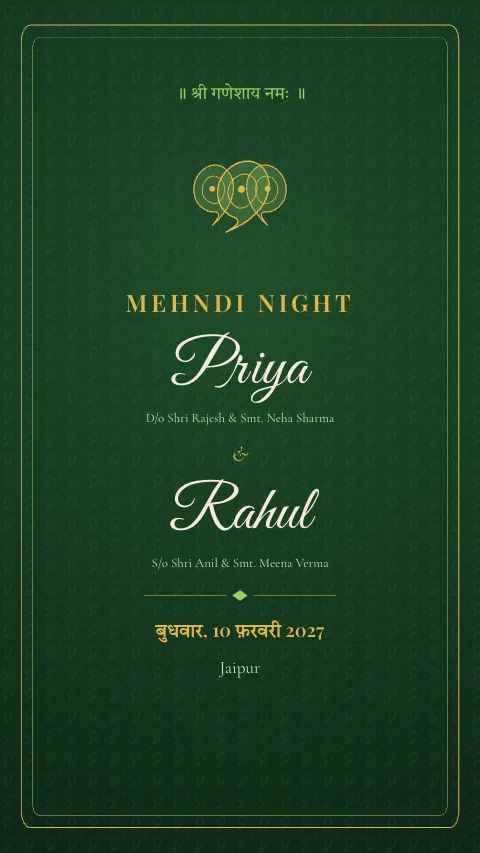
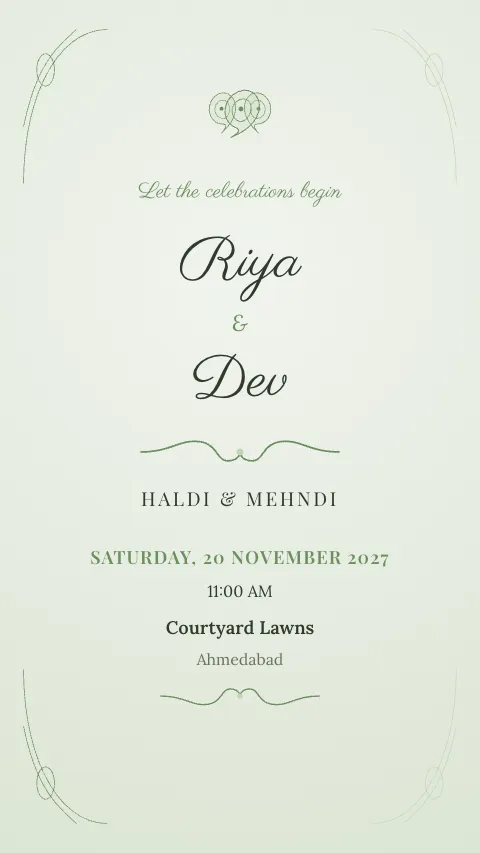
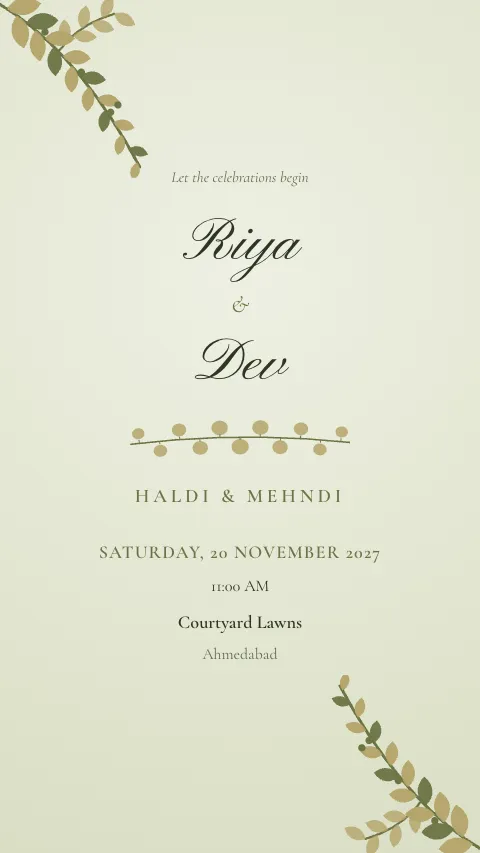
A mehndi design from the store, playing as guests see it. Tap the envelope and turn the sound on; your times, map and dress code go on its pages.
- 1Tap the envelopeIt opens on the guest's screen, with your wax seal and monogram.
- 2Your music beginsTurn the sound on: the song starts as the card unfolds.
- 3The pages come aliveScroll through animated pages, with petals, confetti or lanterns.
Mehndi and pre-wedding designs
See all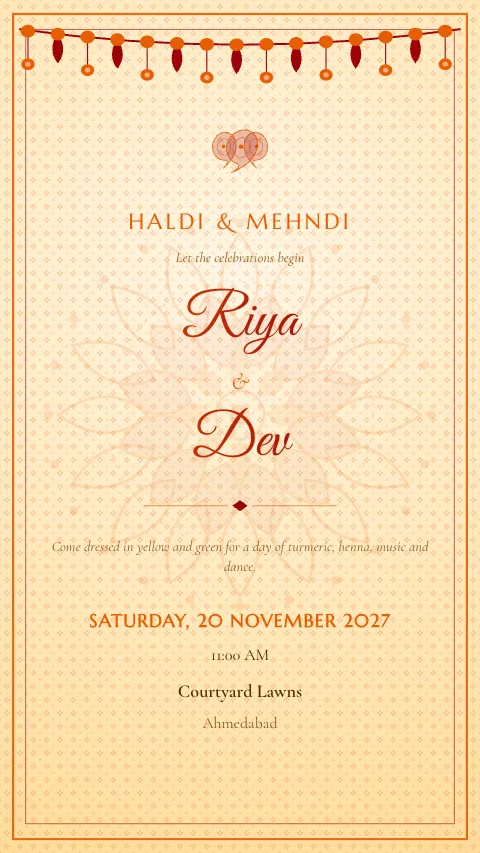
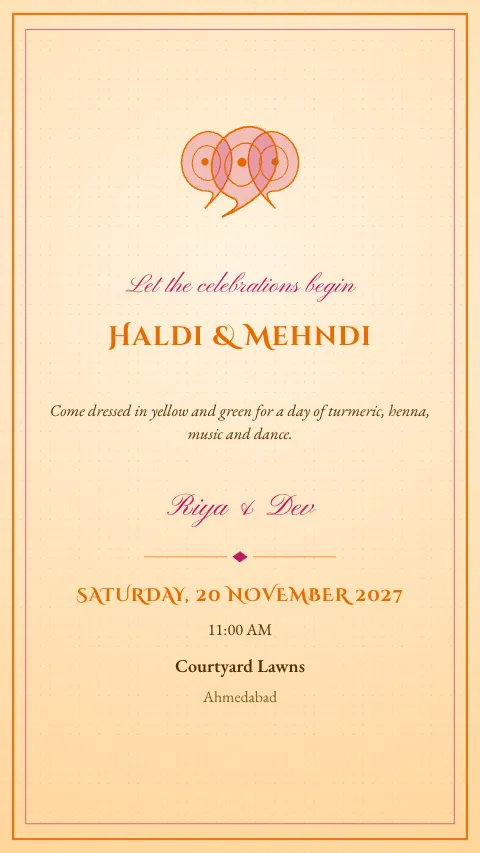
Free to customise: change every word, colour, photo and the music, then share one link.
Each design opens to a page you can edit freely: change the words, add the second time slot for the evening, choose music. You can see the full design at its own page, such as this henna design, and every mehndi, haldi and sangeet design is in the pre-wedding collection. Designing and previewing are free; a wedding invitation with every function, mehndi included, is ₹399 plus GST, as the pricing page explains. For the main card, see our wedding invitation messages.
Key takeaways
- A mehndi ceremony is a pre-wedding celebration in which henna is drawn on the bride's hands and feet, with songs, dancing and food.
- It is usually held one or two days before the wedding, so the colour is at its darkest on the day.
- Hiding the groom's initial in the design is a playful custom: he searches for it after the wedding.
- Guests wear bright colours, often green, with short sleeves and comfortable clothes; avoid black henna.
- Ask guests in the invitation whether they want mehndi, so you book enough artists.
Questions people ask
What do they do at a mehndi?
How many days before the wedding is the mehndi?
What should I wear to a mehndi ceremony?
What should you not wear at a mehndi ceremony?
Do I bring a gift to a mehndi party?
Why is the groom's name hidden in the bride's mehndi?
How do I wish someone on their mehndi ceremony in English?
Does the groom also put on mehndi?
Free to design · each function with its own time, map and RSVP
Invite your family to the mehndi
Read next