Stories
Sangeet ceremony: a Lucknow family, a Ludhiana family and one dance they learnt together
A short story of two families, one from Lucknow and one from Ludhiana, who decided their sangeet would not be a contest between the bride's side and the groom's. After it: what a sangeet means, how it differs from the mehndi, how to plan the evening, what to wear, lines for the anchor and invitation lines to copy.
The FunctionCard team
· 15 min read
Every family remembers its sangeet ceremony by one moment: the grandmother who got up to dance, the uncle who forgot every step, the song an aunt sang that nobody had heard in twenty years. Below is one such evening, told as a story, about two families who had never met before the engagement and decided to learn a single dance together. After it comes everything a family planning its own sangeet needs: what the ceremony means, how the evening runs, what to wear, how to choose the music and how to invite the right people.
Quick answer
What is a sangeet ceremony?
A sangeet ceremony is a pre-wedding evening of music and dance, held a day or two before an Indian wedding. It began as a gathering where the women of the family sang folk songs with a dholak; today both families usually sing, dance and perform for the couple, with food and an open dance floor after the planned performances.
A story
Eight counts from Lucknow to Ludhiana
Chapter 1
Two families, one song
The idea came from Simran, Kabir's cousin, on the evening of the roka, while the two families were still being polite to each other over samosas in the Srivastavas' drawing room in Lucknow's Indira Nagar. "Every sangeet I go to is a war," she said. "Ladkiwale against ladkewale, who has the better choreographer, who has the louder cousins. Why don't we do one dance where everybody is mixed up?"
Meher's mother, Alka, smiled the smile she used for ideas she did not like. "Beta, our side sings. We don't really dance." It was true. The Srivastava women had sung at every wedding in the family for three generations, sitting in a circle on a white chadar with Nani at the dholak, and the men had sat at the edge pretending to read the newspaper.
Kabir's grandmother, whom everybody called Bebe, put down her cup. "Then teach us your songs," she said in Punjabi, "and we will teach you to stand up." The wedding was set for the second week of February in Lucknow, which gave everybody eleven weeks. Simran started a family group that night and named it, after some argument, Eight Counts.
Chapter 2
Rehearsals on a phone screen
The rehearsals happened on Sunday video calls, one phone propped on a bookshelf in Ludhiana's Sarabha Nagar and another on the dining table in Indira Nagar. Simran broke the dance into blocks of eight counts and sent a short video of each block on Monday, so everyone had a week to practise. Meher's Tauji, Pradeep, practised so hard in his drawing room that Taiji moved the glass vase from the corner table to the top of the fridge.
The plan was simple. The first half would belong to Lucknow: Nani would sing a wedding song live, and both families would move slowly around the couple, clapping on the beat. Then the dholak would stop, a dhol player would take over, and the second half would belong to Ludhiana. Nobody was allowed to stay on their own side of the floor.
The hard part was not the steps. It was Nani, who was eighty-one and refused to sing anything over a call. "A song is not for a phone," she said. So for ten Sundays the Gills danced to silence in the first half and to a dhol recording in the second, and only Meher knew the words Nani had chosen.
Chapter 3
The invitation that asked who would dance
Meher's younger brother Anshul was in charge of the invitations, which in practice meant he was in charge of the numbers. The wedding would have four hundred guests; the sangeet, on the lawn of a banquet hall in Gomti Nagar, could seat about two hundred. So the sangeet got its own page in the invitation, with its own time, map and RSVP, and only the families and close friends were invited to it.
On that page, under the time, Anshul typed the dress code Simran had come up with, half as a joke: Lucknow side, wear phulkari. Ludhiana side, wear chikankari. Everybody, wear shoes you can dance in. Below it went one more line: If you'd like to be in the family dance, message Simran by 25 January.
Forty-two people messaged Simran. The replies on the sangeet page told Anshul that one hundred and eighty-six were coming, and he sent that number to the caterer and the tent man the same afternoon. Bebe's reply came through her grandson, who wrote under it: Bebe says she is coming, and she is not sitting on a chair.
Chapter 4
The night of the sangeet
On the night, the lawn was strung with marigold and fairy lights, and the two families arrived dressed in each other's clothes. Punjabi aunts in white chikan kurtas, Lucknowi chachis in orange and pink phulkari dupattas, and the cousins in a mix nobody could sort out. The groom's side performed first, the bride's friends after them, and then the anchor called both families to the floor.
Nani sat on a low stool with the dholak across her knees, and the lawn went quiet. She sang in the Awadhi of her own mother's village, a song she had made up the week before from older lines she half remembered: Lakhnau ki galiyon se chali hai rishton ki baat, Punjab ke aangan tak pahunchi hamari saugaat. Both families moved around Meher and Kabir in a slow circle, clapping on every second beat, exactly as they had practised in silence for ten Sundays.
Then the dholak stopped, the dhol began, and the circle broke apart. Tauji found his eight counts and lost them again. Kabir's father and Meher's father gave up on the steps altogether and simply held each other by the shoulders and jumped. And Bebe, who had been told by three doctors not to dance, stood up from the chair she had promised not to sit in and did two slow bhangra steps with her arms in the air, which was all anyone talked about at breakfast.
Chapter 5
What stayed after the music
The next morning, between the haldi and the packing, two requests went round the Eight Counts group. Bebe wanted Nani's song written down in Gurmukhi so she could learn the words. Nani wanted to know whether the dhol player gave lessons.
Meher watched the video of the circle on her phone while the haldi dried on her arms. In the frame you could not tell which family anyone belonged to. That, she thought, was what a sangeet was for: not the performances, which everyone would forget by the reception, but the evening two families stopped being two sides.
The Srivastavas and the Gills are a made-up family, but most of their evening happens at real sangeets: an elder who leads the old songs, a cousin who choreographs, rehearsals over video calls when families live in different cities, a smaller guest list than the wedding, and the moment the planned performances give way to an open floor. Here is what each part means and how to plan it.
Meaning
What does sangeet mean, and where did the ceremony come from?
Sangeet simply means music. In many North Indian families, and especially in Punjab, the evening began as the ladies sangeet: the women of the bride's family gathered at home in the days before the wedding to sing folk songs with a dholak and a spoon tapped on its side. The songs blessed the bride, teased the groom's family and gave the older women a way to pass wedding songs to the younger ones. Over the last few decades the sangeet has grown into one of the biggest functions of a wedding, often shared by both families, with rehearsed dances, a stage, a sound system and sometimes a hired choreographer. The heart of it has stayed the same: two families getting to know each other through music before the more formal rituals begin.
The mehndi is for the hands, the haldi is for the skin, and the sangeet is for the families: it's the one function where nobody is supposed to stand still.— A saying heard at many sangeets
Not the same
Are mehndi and sangeet the same?
No, though many families combine them. The mehndi is centred on henna: artists draw on the bride's hands and feet, usually in the afternoon, while the women of the family sing and the bride sits still. The sangeet is centred on music and dance, usually in the evening, with performances by both families and a wider guest list. When they are held together, the mehndi runs in the afternoon and the sangeet takes over after dark. Our story of a mehndi ceremony covers that ritual in detail. And the sangeet is always before the wedding, never after it; the function after the wedding is the reception.
The evening
What happens at a sangeet ceremony, in order?
- 1Guests arrive and the families greet each otherSnacks and drinks while the families mingle; in many homes the elders are seated first, near the stage.
- 2Folk songs to openAn elder leads the traditional wedding songs with a dholak. In some families this part is for the women; in others everybody joins in.
- 3Planned performancesDances by cousins, friends, parents and the couple, usually two to four minutes each, introduced by an anchor or a confident cousin.
- 4The couple's danceOften the last planned act, sometimes a surprise from one partner to the other.
- 5Dinner and an open floorThe DJ or dhol takes over, dinner is served, and the evening runs late.
Planning
How do you plan a sangeet ceremony, week by week?
A sangeet plan for a wedding season wedding
Ten to twelve weeks before
Decide whether the sangeet is separate or combined with the mehndi, fix the venue and book a choreographer if you want one; good ones fill their dates early in wedding season.
Eight weeks before
Make the run order: who performs, which songs, how long each act is. Keep the whole programme under ninety minutes so dinner isn't late.
Six weeks before
Start rehearsals. If families live in different cities, record each block of steps and share it, then practise together on video calls.
Four weeks before
Send the invitation with the sangeet's own time, venue and RSVP, and the dress code if there is one.
Ten days before
Count the replies, confirm the number with the caterer, and send the final song files to the DJ or sound person.
The day before
A full rehearsal at the venue with the sound system, so nobody meets the stage for the first time on the night.
The night
Elders' songs first, performances next, then dinner and the open floor.
Keep each act short
Three minutes feels short when you rehearse and long when you're watching. Ask every group to cut their song to two or three minutes, and put the elders' songs at the start, when everyone is still listening.
Dress code
What is the sangeet dress code, and what colours should you avoid?
The sangeet is the most glamorous of the pre-wedding functions, so most guests dress up: lehengas, shararas, shimmer sarees, gowns and indo-western outfits for women; kurtas with a Nehru jacket, bandhgalas or light sherwanis for men. Bright jewel colours, metallics and pastels all work. What matters most is that you can move: a skirt that doesn't trip you, a dupatta you can pin, and shoes you can dance in for three hours. On colours, follow the invitation first. Unless it says otherwise, many families avoid all-black or all-white at wedding functions, red is often left for the bride, and it's polite not to match the bride's outfit if she has announced her colour. A theme, such as one colour for each family or the swap the Gills and Srivastavas chose, belongs on the invitation so everyone knows in time.
Music
Which songs work best for a sangeet?
The best sangeet playlists mix three kinds of music. Open with traditional songs that the elders know: suhaag and banna-banni songs, Punjabi boliyan and tappe, Rajasthani, Awadhi, Bhojpuri or Gujarati wedding songs, whatever your families sing. Use film and pop songs for the rehearsed performances, choosing songs with a clear beat that non-dancers can follow. And save the fastest tracks for the open floor after dinner. If both families come from different regions, let each side pick one song from home; it is the easiest way to make the evening feel like it belongs to both of them.
Hosting
What should the sangeet anchor say?
Every sangeet needs one person with a microphone who keeps the evening moving: a hired anchor or a cousin who doesn't mind the spotlight. Their job is to welcome guests, introduce each act in a line or two, keep the elders included and hand over to dinner on time. These lines are original and ready to adapt.
Lines for the sangeet anchor
Good evening, everyone! Tonight two families become one, and the only rule is that nobody leaves this lawn without dancing at least once.
Before the speakers take over, let's begin the way every wedding in this family has begun: with our elders and their songs. Please welcome [Name] at the dholak.
Next, the people who have known the bride longest and embarrass her most: her college friends!
They've rehearsed for weeks, they've argued about every step, and they've promised not to fall off the stage. Please welcome the groom's cousins!
Ladies and gentlemen, the parents! They said they wouldn't dance. Let's see how long that lasts.
And now, the reason we are all here. Please clear the floor for [Name] and [Name].
Dinner is served, the dance floor is open, and the DJ has been told not to stop until the families are tired. Thank you for coming!
Invitations
How do you invite guests to a sangeet ceremony?
Most families invite a smaller circle to the sangeet than to the wedding: both families, close friends and the people performing. That makes a separate headcount important, because the caterer, the seating and the stage all depend on it. With a FunctionCard invitation the sangeet gets its own page with its own date, time, venue map, add-to-calendar button, note and RSVP, so you see how many are coming to the sangeet separately from the wedding. You can invite some guests to the sangeet and others only to the wedding, and each family's personal link greets them by name. Put the dress code and a line about the family dance in the sangeet's note. For more wording help, try the invitation message writer.
Sangeet invitation lines
Music, dance and two families on one floor: join us for [Name] and [Name]'s sangeet on [Date] at [Time], [Venue]. Wear something you can dance in!
The dholak is tuned, the cousins have rehearsed and the dance floor is waiting. You're invited to the sangeet of [Name] and [Name] on [Date], [Time].
With the blessings of our elders, we invite you and your family to an evening of songs and celebration at the sangeet of [Name] and [Name], [Date], [Venue].
Before the pheras, the performances. Come and cheer (or dance) at our sangeet on [Date] at [Venue]. Dress code: [Colour or theme].
Want to be in the family dance? Reply to this invitation and message [Name] by [Date]. Everyone else: come ready to clap!
संगीत संध्या के निमंत्रण
[नाम] और [नाम] की संगीत संध्या में आप सपरिवार सादर आमंत्रित हैं। दिनांक [तारीख], समय [समय], स्थान [पता]।
ढोलक की थाप, गीतों की बहार और दोनों परिवारों का साथ: संगीत की इस शाम में आपका इंतज़ार रहेगा। [तारीख], [समय]।
नाचने के लिए आरामदायक जूते पहनकर आइए! [नाम] और [नाम] की संगीत संध्या, [तारीख] को [स्थान] पर।
Try it live
This is what your guests see
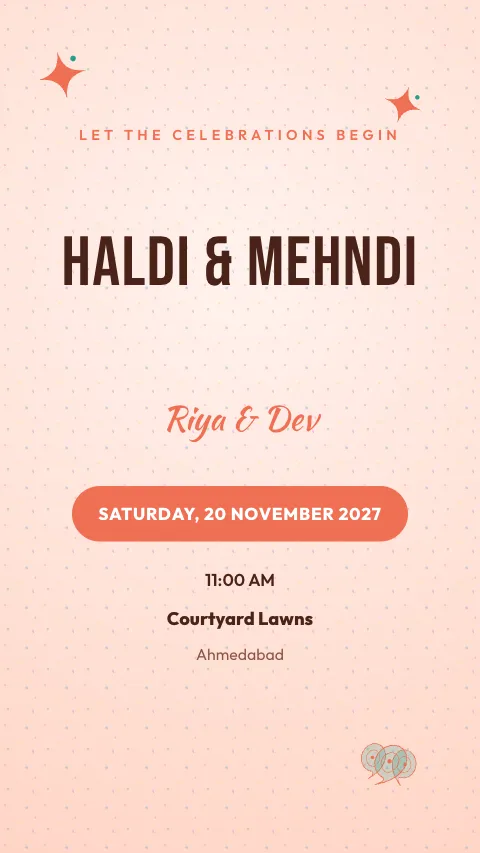
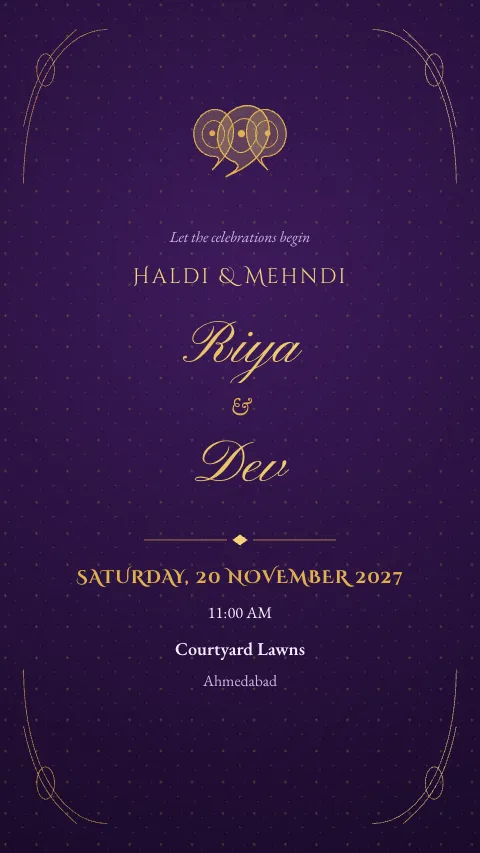
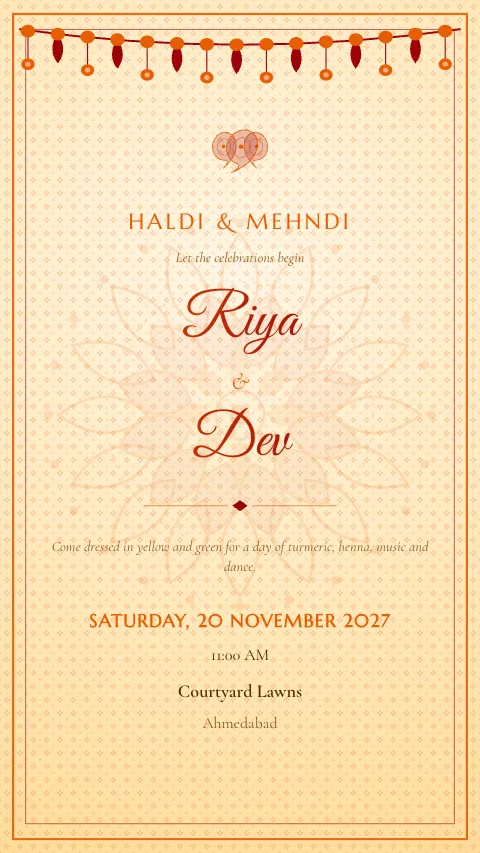
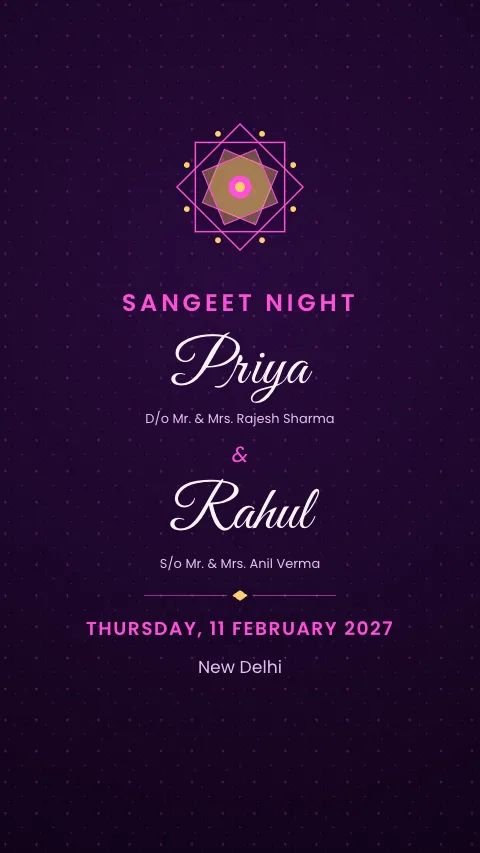
A sangeet design from the store, playing as guests see it. Tap the envelope and turn the sound on; your time, map, dress code and RSVP go on its pages.
- 1Tap the envelopeIt opens on the guest's screen, with your wax seal and monogram.
- 2Your music beginsTurn the sound on: the song starts as the card unfolds.
- 3The pages come aliveScroll through animated pages, with petals, confetti or lanterns.
Sangeet and pre-wedding designs
See all
Free to customise: change every word, colour, photo and the music, then share one link.
Every design can be changed freely: the words, the colours, the music and the photos. You can see the full design on its own page, such as this sangeet night design, and all the sangeet, mehndi and haldi designs are in the pre-wedding collection. Designing and previewing cost nothing; one invitation with every function, sangeet included, is ₹399 plus GST to publish, as the pricing page explains. Planning the morning after? Read our story of a haldi ceremony.
Key takeaways
- A sangeet ceremony is a pre-wedding evening of music and dance, held a day or two before the wedding.
- It grew from the ladies sangeet, when the women of the family sang folk songs with a dholak; today both families usually perform.
- The mehndi is about henna and the sangeet about music; many families hold them on the same day, mehndi first.
- Keep acts to two or three minutes, start with the elders' songs and rehearse once at the venue with the sound system.
- Give the sangeet its own invitation page and RSVP, because its guest list is usually smaller than the wedding's.
Questions people ask
What is the meaning of a sangeet ceremony?
Is the sangeet before or after the wedding?
Are mehndi and sangeet the same?
What is the dress code for a sangeet?
What colours should you not wear to a sangeet?
How long does a sangeet ceremony last?
Who performs at a sangeet?
Do guests bring a gift to the sangeet?
Free to design · every function with its own time, map and RSVP
Invite your families to the sangeet
Read next