Compared
Shadi card design: how to choose one, and what changes between paper and a phone screen
Most families choose a shaadi card design by holding a sample in their hands. But most guests will first see it on a phone, five inches wide, in a family WhatsApp group. Here is how to pick a design that looks right in both places, what each tradition expects, and how printed and digital designs really compare.
The FunctionCard team
· 11 min read
Choosing a shadi card design used to mean an afternoon at the card shop: the owner pulling down sample after sample, the weight of each one in your hand, an aunt running her thumb over the gold to check it was raised. That afternoon still matters, but the first time most guests see your card today is on a phone, in a chat, at the size of a matchbox. Velvet, laser cuts and embossing don't travel through a screen; contrast, clear type and a good layout do. This guide shows how to choose a design that works in both places, what each tradition looks for, and an honest comparison of printed and digital designs.
Quick answer
How do you choose a shadi card design?
Start with your family's tradition and symbols, then the colours, then the format. Check that the names and date are readable on a phone screen, that the design has room for every function, and that elders get what they expect in hand. Many families now pick one design and use it twice: a digital invitation for everyone and a few printed copies for elders.
Styles
What kinds of shadi card design are there?
- Traditional Hindu designs: red, maroon and gold, with Ganesh ji, a kalash, a toran or a mandap, and Shri Ganeshaya Namah at the top.
- Royal and palace designs: arches, jharokhas, elephants and peacocks, usually in deep jewel colours with gold borders.
- Floral and pastel designs: blush, sage, ivory and peach with watercolour flowers; popular with couples who want something lighter.
- Regional designs: a Paithani peacock for a Marathi lagna patrika, Kanjeevaram silk borders for a Tamil wedding, a red kankotri for a Gujarati family, phulkari colours for a Punjabi one.
- Muslim wedding designs: emerald, ivory and gold, crescents and geometric patterns, often opening with Bismillah or a dua, for a nikah and walima.
- Sikh wedding designs: Ik Onkar at the top and the Anand Karaj at the gurdwara, often in kesari or blue.
- Photo designs: a couple photo, a pre-wedding shoot or an illustration of the two of you, framed in an arch, a circle or a heart.
A few designs, one from each style
See all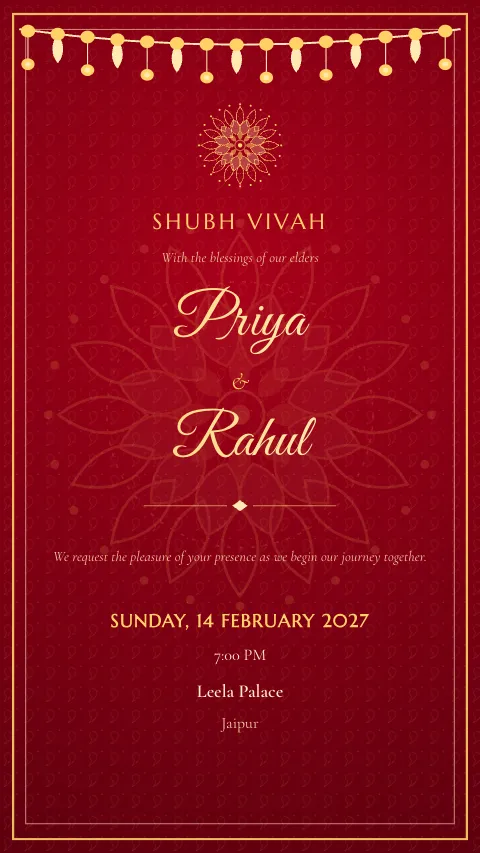
Crimson Toran
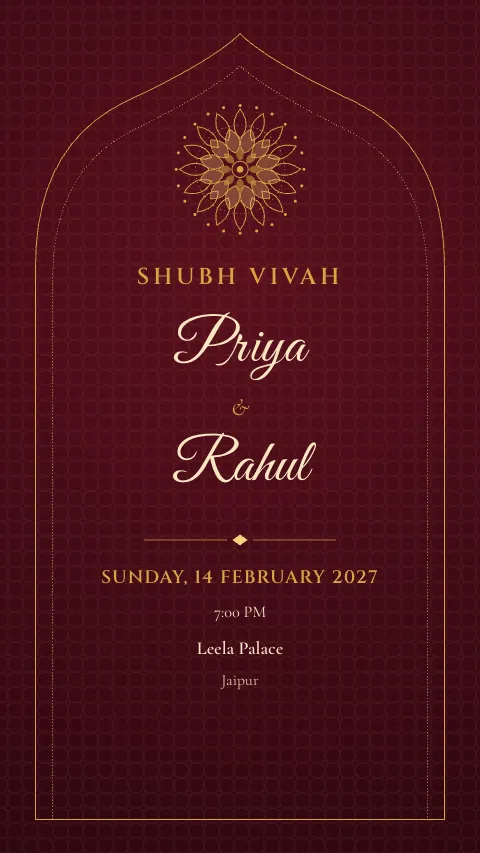
Royal Durbar
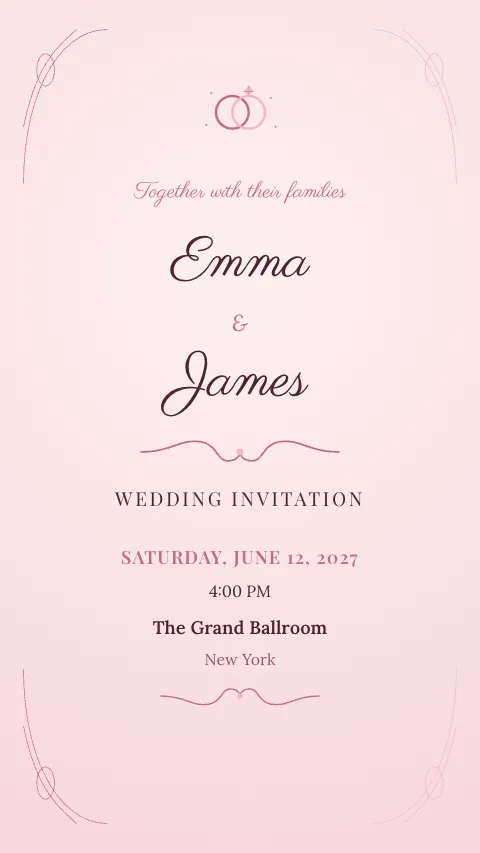
Blush Garden
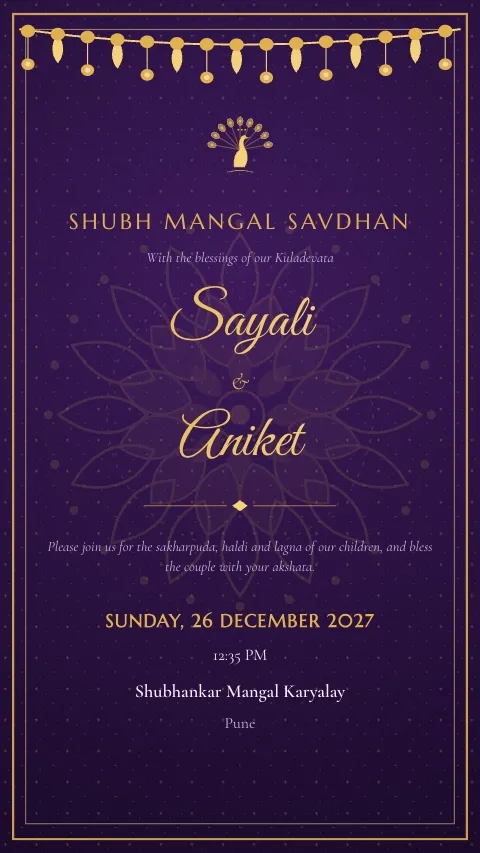
Paithani Peacock
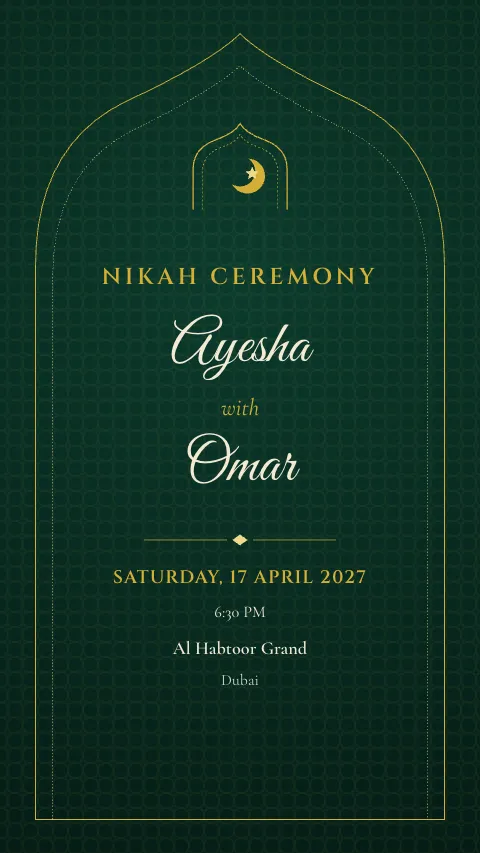
Emerald Nikah
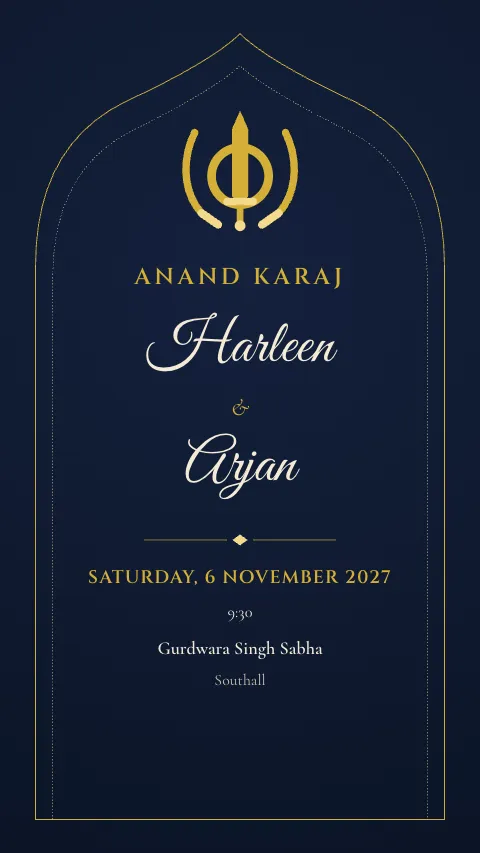
Gurdwara Blue
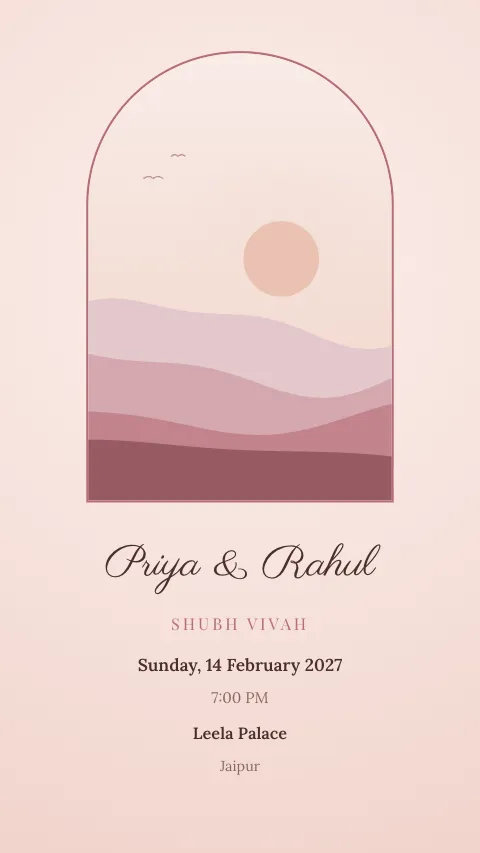
Pheras Portrait
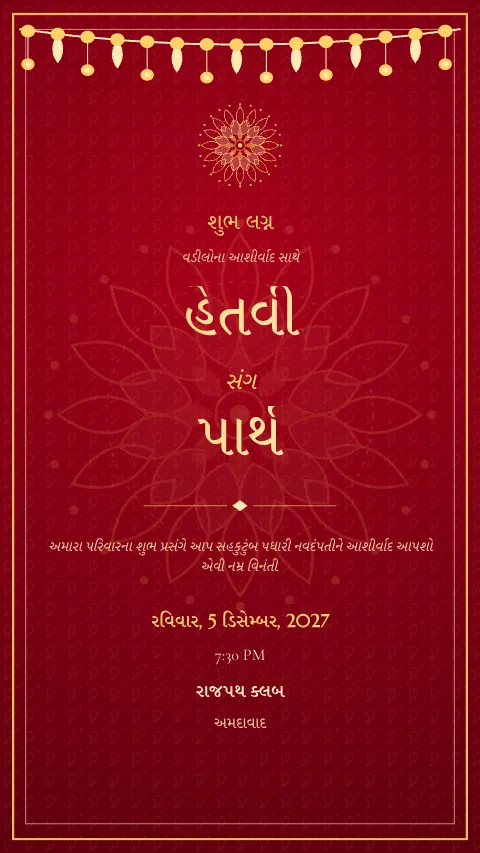
Kankotri Red
Free to customise: change every word, colour, photo and the music, then share one link.
Paper or phone
Is a printed shadi card design better than a digital one?
Neither is better everywhere; they are good at different things. A printed card is an object: it has weight, texture, a box or an envelope, and it can be carried to an elder's home with a box of sweets. A digital design is a message: it reaches four hundred guests in a minute, it can play music, and it can carry the map, the calendar entry and the reply button. Between them sit two in-between kinds: a picture or PDF made in a design app, which looks like a printed card on a screen but does nothing else, and a video, which moves but can't be answered. The table compares the four on what families usually care about.
Digital invitation vs printed card vs picture or PDF vs video
| Feature | FunctionCard | Printed card | Picture or PDF | Video |
|---|---|---|---|---|
| Feels special in the hand | Partly | |||
| Clear to read on a phone | Partly | Partly | ||
| A phone-sized layout | Partly | |||
| Envelope, music and moving pages | ||||
| Every function on its own page | Partly | Partly | Partly | |
| Change the venue or time after sending | ||||
| Map, calendar and RSVP buttons | ||||
| Each family greeted by name | Partly | |||
| Written in your language with proper fonts | 53 languages | Depends on the press | Depends on the app | Depends on the maker |
| Cost grows with the guest list | ||||
| Ready the same day | Partly | |||
| A keepsake for the couple | Partly | Partly | Partly |
What FunctionCard does today, against what is typical for each other kind. Individual presses, apps and video makers differ.
On a phone
What makes a shaadi card design look good on a phone?
Hold the design at arm's length on your own phone before you choose it, because that is how guests will see it first. A few things decide whether it works. Shape: a phone screen is tall and narrow, so a design laid out for a portrait phone screen fills it, while a wide printed card shrinks to a strip. Contrast: gold on cream looks rich on paper and faint on a screen in daylight; deep red, maroon, emerald or navy with light text reads far better. Type size: the couple's names and the date should be readable without zooming, and long paragraphs of family names belong on a later page, not the first. Texture: embossing, foil and laser cuts are invisible in a photo, so a design that depends on them looks flat on a phone; a digital gold effect and a little movement do that job instead.
FunctionCard
- Laid out for a phone first, with print and square sizes a tap away
- An envelope that opens, music, and petals or confetti as the pages turn
- Each function on its own page with a map, a calendar button and an RSVP
- Edit the published design, and the link everyone already has shows the change
- Downloads as a print-ready PDF with a QR code, plus PNG pictures and an MP4
- Free to design and preview; one payment when you publish
Traditions
Which shadi card design suits your family's tradition?
Quick pick
Which tradition is your wedding?
Tap the one that sounds like you.
Contents
What should a shadi card design have room for?
- 1An invocationShri Ganeshaya Namah, Bismillah, Ik Onkar, a shloka or a family line, at the very top.
- 2Who is invitingUsually the parents or grandparents, with the family names; some couples now invite in their own names.
- 3The coupleBoth names, often with son of and daughter of, large enough to read on a phone.
- 4Every functionHaldi, mehndi, sangeet, wedding and reception, each with date, time and venue; a design that crams them into one line is hard to read.
- 5RSVP and contactsA reply-by date, a contact name and number, and in a digital card the reply button itself.
Check the spelling in every script
A design that looks perfect in English can break in Hindi, Marathi, Gujarati or Urdu if the font doesn't support the script: missing matras, wrong joins, boxes instead of letters. Read the names in your language on the actual design, ideally with an elder, before anything goes out.
Money
How much does a shadi card design cost?
A printed card's price depends on paper, size, inserts, the box, the printing method and the quantity, so the bill grows with the guest list and the extras. A picture made in a design app can be free, or cost a little for a premium template or to remove a watermark. A designer's video is usually one fee. On FunctionCard, designing and previewing every design costs nothing, and publishing one wedding invitation with every function is ₹399 plus GST on the Starter plan, paid once, whatever the number of guests. Move the slider and put your own quotes in place of the guesses below; see the pricing page for what each plan includes.
What would your shaadi cards cost?
FunctionCard
₹471
Printed cards
₹17,000
Design app picture
₹500
Designer video
₹2,000
At 400 guests, FunctionCard costs ₹29 less than the cheapest option above.
Every figure except FunctionCard's is a guess for you to replace: presses price by paper, size, inserts, boxes and quantity, and designers by the rounds of changes. FunctionCard's figure is the real price.
Step by step
How do you make a shadi card design online?
Open the wedding designs and pick one that fits your tradition. Fill in your details once, the names, families, functions, dates and venues, and they appear on every page. Change the words, fonts and colours, replace the sample photo with your own, and choose a song. Preview the whole invitation as a guest would see it, for free. When it's right, publish it and share the link; then download the PDF for the few printed copies you'll carry to elders. Our wedding card maker guide walks through every step, and the invitation message writer helps with the words.
Try it live
This is what your guests see
A traditional design from the store, playing as guests see it. Tap the envelope and turn the sound on; each function, map and RSVP sits on its own page.
- 1Tap the envelopeIt opens on the guest's screen, with your wax seal and monogram.
- 2Your music beginsTurn the sound on: the song starts as the card unfolds.
- 3The pages come aliveScroll through animated pages, with petals, confetti or lanterns.
Honestly
When is a printed shadi card the better choice?
When the card itself is part of the ritual. In many families the first card goes to the family deity or the temple, and the next ones are carried by hand to grandparents, elders and important relatives with sweets or dry fruit. For those visits, a printed card shows respect in a way a phone can't. It is also the better choice if you want a box, velvet or laser-cut keepsake for the album. The sensible answer for most weddings is both: print a small number for the people who should receive a card in hand, and send the digital invitation to everyone else. Because a FunctionCard invitation downloads as a print-ready PDF with a QR code to the live invitation, the printed copies and the link can share one design.
Our verdict
Choose for the screen, print for the elders
Pick a design that reads clearly on a phone, because that is where most guests meet it first, and that fits your tradition's symbols and language. Print a few copies when elders and rituals call for a card in hand. Use a picture for a quick forward, a video for a status post, and an invitation link whenever guests need the venue, the timings and a way to reply.
A card for the temple and the elders' homes
A printed card
A box or velvet keepsake for the album
A printed card
Several functions with different venues
FunctionCard link
Guests in many cities and abroad
FunctionCard link
A quick status post
A video, or FunctionCard's MP4 download
Key takeaways
- Most guests first see a shadi card design on a phone, so test it on one before you choose.
- Strong contrast, clear names and a tall layout matter more on a screen than foil, embossing or laser cuts.
- Match the design to your tradition's symbols and write it in your family's language with a proper font.
- Printed cards are best for elders, rituals and keepsakes; a digital invitation is best for reach, timings, maps and replies.
- One design can do both: on FunctionCard, publish the invitation for ₹399 plus GST and print a few copies from its PDF.
Questions people ask
Which shadi card design is in trend right now?
Which colour is best for a wedding card?
Can I add our photo to the shadi card design?
Can I make a shadi card design in Hindi?
Can I get a digital shadi card design printed?
How many days before the wedding should the shaadi card be sent?
Can I make a Muslim shadi card design?
Free to design and preview · pay once to publish
Find a shadi card design that works on every phone
Read next