Compared
Engagement invitation card: printed, free image, video or link? An honest comparison
An engagement is often fixed in a hurry, the guest list changes twice, and half the family lives in another city. Here is how a printed card, a free image with your names, a video and an invitation link compare for a small roka at home or a ring ceremony in a banquet hall.
The FunctionCard team
· updated · 12 min read
An engagement invitation card has a harder job than it looks. The date is often fixed only two or three weeks ahead, sometimes after a pandit has looked at both horoscopes. The guest list is small but scattered: grandparents in the hometown, an uncle in Dubai, the couple's friends from college. And plans change, because the venue moves or the muhurat shifts by an hour. Printed cards, a free image with your names on it, a short video and an invitation link all handle this differently. Here is an honest comparison, with the cases where each one is the right choice.
Quick answer
Which engagement invitation card should you choose?
Choose a printed card if elders expect one in hand and you have three weeks to print and deliver. Choose a free image with your names for a small family roka where nothing will change. Choose a video for a status post. Choose an invitation link when guests are in many cities, you need a headcount for the caterer or the timing might move.
Four formats
What kinds of engagement invitation card are there?
Printed cards are designed and printed by a local press or an online printer, usually on thick card with an envelope, and delivered by hand or courier. A free image with name editing comes from sites and phone apps where you pick a design, type your names, date and venue, and download a picture or a PDF to forward on WhatsApp. A video invitation is a short clip, often vertical, with music, photos and animated text, made in an app or by a designer. An invitation link, such as a FunctionCard invitation, is a web page: the guest taps it, an envelope opens, music plays and the card unfolds, with buttons for the map, the calendar and the reply.
Invitation link vs printed card vs free image vs video
| Feature | FunctionCard | Printed card | Free image or PDF | Video |
|---|---|---|---|---|
| Ready on the day the date is fixed | Partly | |||
| Lands with the uncle abroad in seconds | ||||
| A card to hand to grandparents | Partly | Partly | ||
| Sound and movement | ||||
| Muhurat moves by an hour: update it | ||||
| One tap opens the route to the hall | Partly | |||
| Families say yes, no and how many | ||||
| A final number for the caterer | ||||
| Opens with the guest family's own name | Partly | |||
| Saves the ceremony in the guest's calendar | ||||
| Shareable as a status or story | ||||
| No watermark on what guests see | Partly | Partly | ||
| Marathi, Gujarati, Urdu and more | 53, with fonts | Depends on the press | Depends on the site | Depends on the maker |
| Shagun and blessings sent by UPI | Partly |
What FunctionCard does today, against what is typical for each other kind. Individual presses, editors and video makers differ.
Small or big
Does a small roka need a card at all?
Often it doesn't. A roka or a first meeting of families at home is usually for twenty or thirty close relatives, decided days in advance, and a phone call from the elders is the invitation that matters. If you send anything, a simple image with the date, time and address on the family WhatsApp group is enough. A ring ceremony in a banquet hall or a lawn is different: a hundred or more guests, a caterer who needs a number, a venue some people have never been to, and friends who were never on the family group. That is where replies, a map and the chance to update the timing start to matter.
Ask for replies by a date
Caterers usually want a final number a few days before the event. Put a reply-by date under the time, and on a FunctionCard invitation guests tap RSVP and say how many are coming, so the total is in one place instead of scattered across fifty chats.
Free editors
Is a free engagement card with name editing good enough?
For many families, yes. Free name-editing sites and apps are quick: pick a design, type both names and the details, download, forward. Before you choose one, check four things. Is there a watermark on the free download? Does the design have room for the parents' names and a shloka or a dua, which elders often expect? Can you write in your language with a proper font, rather than English letters for a Marathi or Gujarati name? And remember the limits of a picture: if the venue changes, you send a new image and hope everyone deletes the old one; and every reply arrives as a separate message. If none of that worries you, a free image is a sensible choice.
FunctionCard
- An envelope that opens, a song, pages that turn and petals or confetti falling
- The hall on a map, a calendar button and replies that add up to one number
- If the muhurat shifts, edit once and the link everyone has shows it
- Each family can get its own link that opens with their name
- Export a PDF for printing, with a QR code back to the live card, plus pictures and an MP4
- Nothing to pay while designing; one payment when you publish
Wording
What should an engagement invitation card say?
- An opening blessing if your family uses one: Shri Ganeshaya Namah, Bismillah, Ik Onkar or a line of your own.
- Who is inviting: usually the parents or grandparents, with the family names.
- The couple's names, often with their parents' names: son of, daughter of.
- What the function is called in your family: engagement, ring ceremony, sagai, mangni, sakharpuda, gol dhana or nischitartham.
- The date, day and time, and the muhurat if there is one.
- The venue name and full address, with a map link.
- Dinner or lunch, a dress code if any, and a reply-by date.
- A contact name and number for questions.
Short lines for the card or the WhatsApp message
With the blessings of our elders, we invite you and your family to the engagement ceremony of [Name] and [Name] on [Date] at [Time], [Venue]. Dinner follows.
Two families, one promise. Join us as [Name] and [Name] exchange rings on [Date] at [Venue]. Please reply by [Date] so we can plan.
The rings are ready and so are we! Celebrate [Name] and [Name]'s ring ceremony with us on [Date], [Time].
आपको सपरिवार [नाम] और [नाम] की सगाई के शुभ अवसर पर सादर आमंत्रित करते हैं। दिनांक [तारीख], स्थान [स्थान]।
Engagement and ring ceremony designs
See all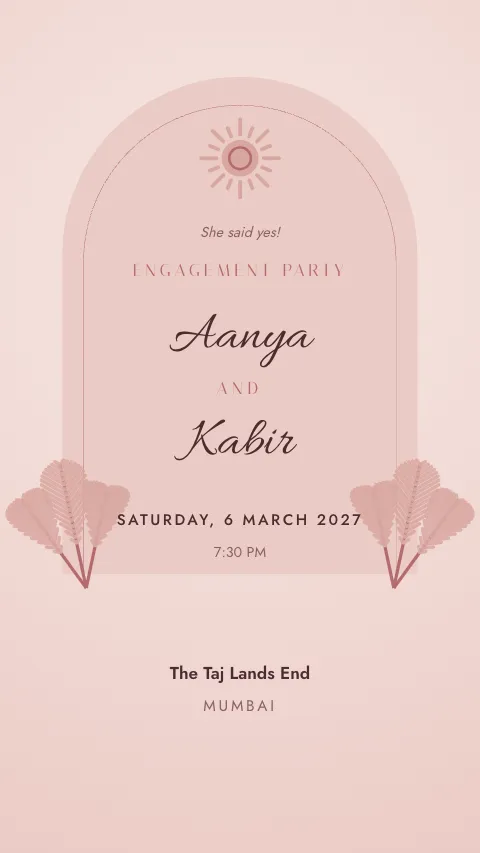
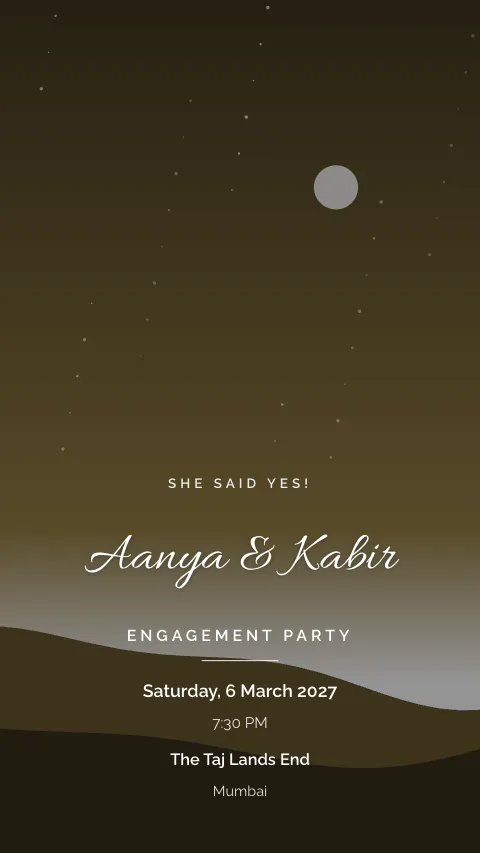
Free to customise: change every word, colour, photo and the music, then share one link.
Money
How much does an engagement invitation card cost?
With printing you pay for every card, and the press adds its design work and the courier, so a longer guest list means a bigger bill. A free image costs nothing, or a little to lose the watermark. A video from a designer is normally one fee however many people receive it. On FunctionCard, designing and previewing cost nothing; publishing it on the Starter plan is ₹399 plus GST, and that one payment covers the link, the printable PDF, the pictures and the MP4. Sending the engagement together with the wedding functions? The same invitation holds every function at no extra cost. Slide the guest count and replace the guesses below with your own quotes.
What would your engagement invitations cost?
FunctionCard
₹471
Printed cards
₹6,500
Video from a designer
₹1,500
Free image, watermark removed
₹200
A press's price moves with paper, size, envelopes, quantity and courier; a designer's with the rounds of changes. Every default here is a guess for you to overwrite, except FunctionCard's, which is the actual price.
Language
Can you make an engagement card in Marathi, Gujarati or another language?
Yes, and for many families it is the point. A sakharpuda invitation reads best in Marathi, a gol dhana invitation in Gujarati, a nischitartham in Telugu, and grandparents notice. On FunctionCard designs work in 53 languages with fonts made for each script, so a Devanagari or Gujarati name looks right rather than squeezed into an English typeface. You can also keep a blessing in one language and the details in another, which is common when the two families come from different states.
Step by step
How do you make an engagement invitation card online?
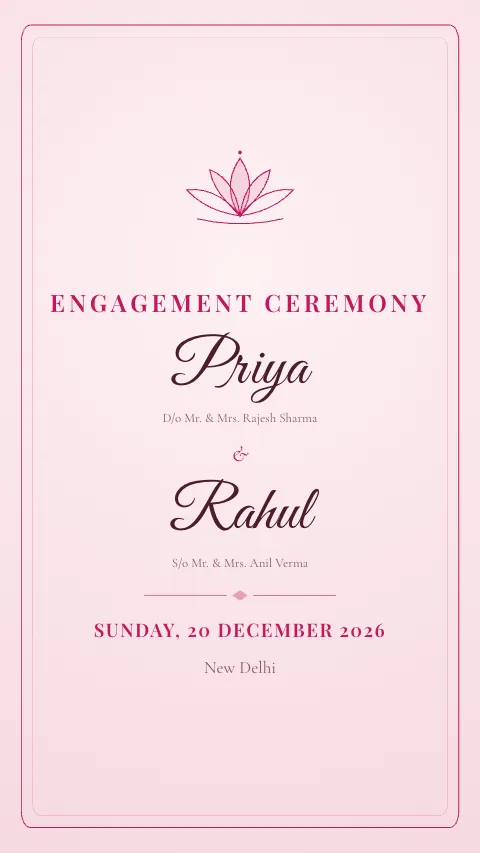
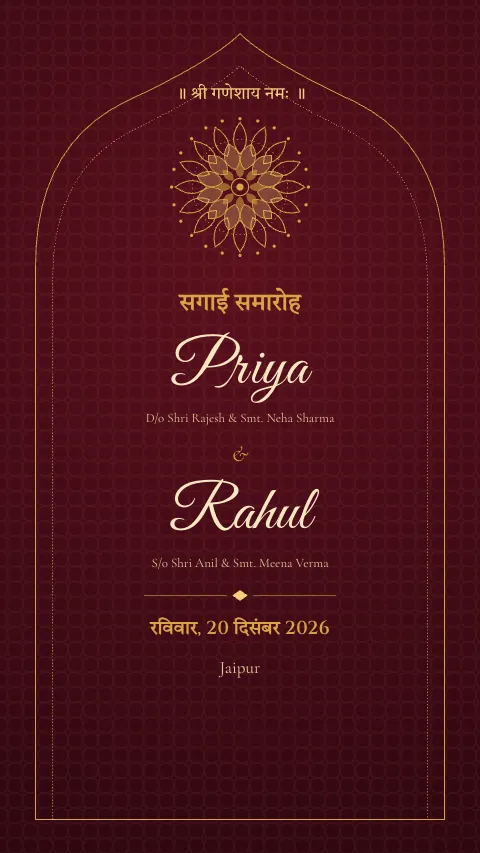
- 1Choose a lookOpen the engagement designs: traditional sagai cards in red and gold, soft pastel ring ceremony cards, modern ones with a photo.
- 2Type the couple and family namesBoth names, the parents, the muhurat, the hall: entered once, they appear on every page.
- 3Add your touchesSwap in a shloka or a dua, a photo of the two of you, a song and an effect, then watch the whole thing as a guest would, without paying.
- 4Publish, then shareOne payment publishes it. Post the link in the family groups, email it, or give each household a link that opens with their name.
- 5Print the elders' copiesTake the PDF to a print shop for the cards you'll carry with sweets; its QR code leads back to the live invitation.
Try it live
This is what your guests see
A ring ceremony design from the store, playing as guests see it. Tap the envelope and turn the sound on; the venue map and RSVP sit below the card.
- 1Tap the envelopeIt opens on the guest's screen, with your wax seal and monogram.
- 2Your music beginsTurn the sound on: the song starts as the card unfolds.
- 3The pages come aliveScroll through animated pages, with petals, confetti or lanterns.
Honestly
When is a printed engagement card the better choice?
When the people who matter most don't read invitations on a phone. In many families the engagement card is carried to the elders on both sides, with sweets, as a mark of respect, and an image on WhatsApp would feel too casual. A printed card is also a keepsake for the couple's album. If you have the time, print a small number for those visits and send the link to everyone else; because a FunctionCard invitation downloads as a print-ready PDF with a QR code, the printed card and the link can be the same design.
Quick pick
What kind of engagement are you planning?
Tap the one that sounds like you.
Our verdict
Print for respect, link for planning
A printed card is best for elders and keepsakes when there is time to print. A free image is enough for a small roka that won't change. A video is good for a status post but takes no replies. An invitation link is best whenever guests need a map, you need a headcount or the plan might move, and with a print-ready PDF it covers the printed cards too.
Carrying the card to elders with sweets
A printed card
A family roka on short notice
A free image on WhatsApp
A caterer needs a final number
FunctionCard link
Relatives in other cities and abroad
FunctionCard link
A status post or reel
A video, or FunctionCard's MP4 download
Key takeaways
- Engagement dates are often fixed only weeks ahead, so the slow part of a printed card is the printing and the delivery.
- A free image with your names suits a small roka; it just can't be corrected once sent, and replies come as scattered messages.
- A video is lovely as a status, but guests can't find the hall, save the date or reply from it.
- A link gives guests the route, a calendar entry and a reply button, and lets you correct the timing later.
- Designing on FunctionCard is free; one engagement costs ₹399 plus GST to publish, printable PDF included.
Planning the wedding next? Our comparison of a digital wedding invitation and a printed card goes deeper into elders and printing, and the video invitation comparison covers reels and status posts. For wording, try the free invitation message writer.
Questions people ask
How do I make an engagement invitation card with name editing for free?
How many days before the engagement should invitations be sent?
Can I get my engagement invitation as a PDF?
Can I add our photo to the engagement card?
What is an engagement called in different communities?
Can I make a Muslim engagement invitation card?
Can I change the engagement time after sending the invitation?
Free to design · pay only to publish
Make an engagement invitation guests can reply to
Read next